Althomes — A Booking Site That Runs Like a Business
Gave a short-stay rental brand a website that runs itself, with live booking availability, owner-editable everything, automated enquiries, and a hosting bill kept near zero. Solo, from content model to deployment.
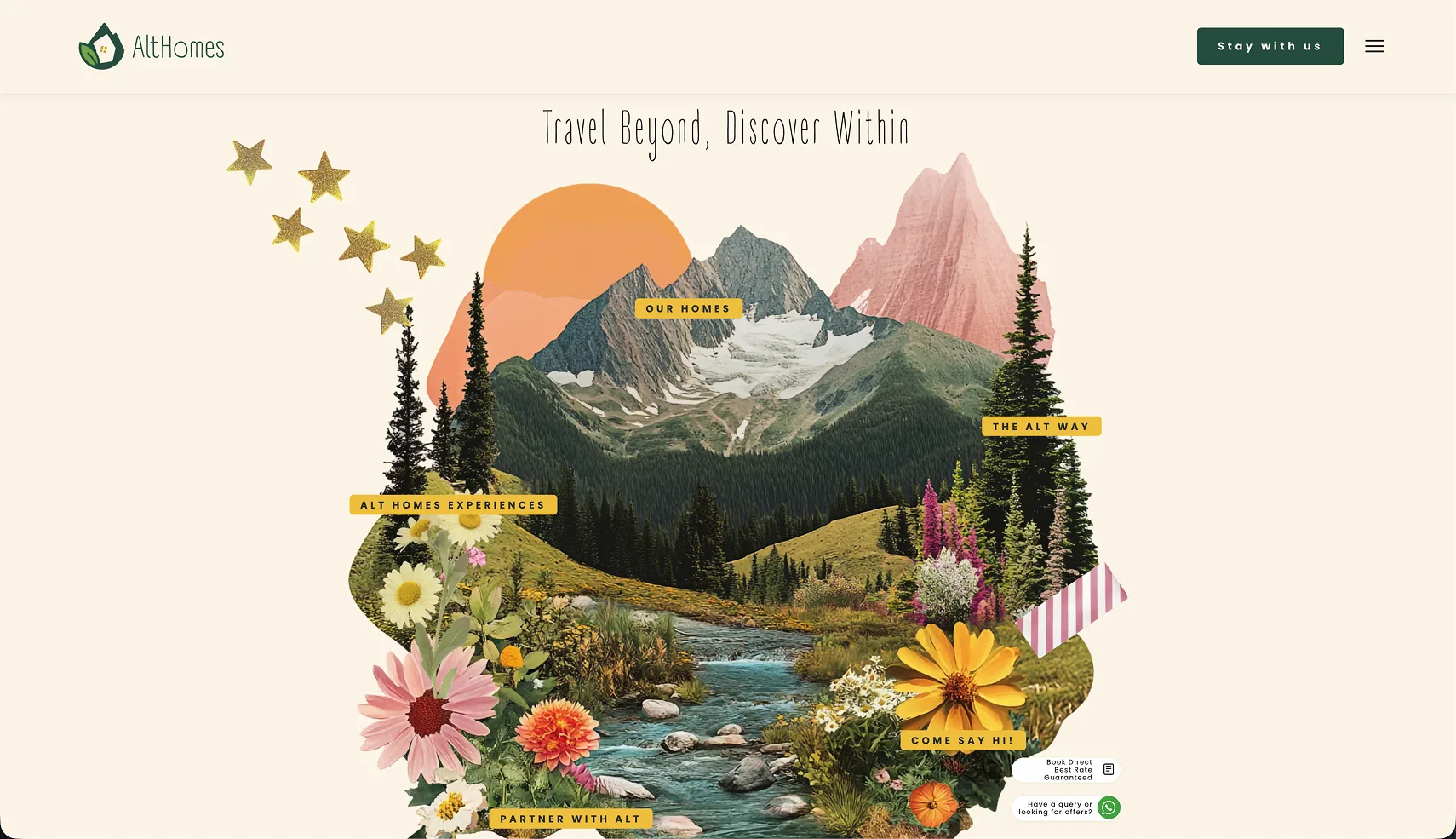
Althomes is a curated short-stay rental brand. They needed a real booking website where guests check live availability, enquiries land in an inbox, and every page is editable without a developer, all at a running cost that made sense for a small business. I designed and built the whole thing solo, from the content model down to the Docker image it ships in.
Note Built and shipped solo across two environments: product design, full-stack engineering, and infrastructure. AI voice agents are in prototyping now.
The Third Option
Small brands get two bad deals. So I built Althomes the right one.
Pay little for a brochure you can't change without a developer, or pay a lot for a custom site locked to one agency and costly to move. Either way the business loses.
A self-running platform Althomes owns outright: real bookings, self-serve content, near-zero hosting. Cheap to run, theirs to keep, nobody's leash.
What I Built
A complete, self-running platform, not a page but a working business. The owner assembles every page, photo, listing, blog post, and even the navigation menu from a single dashboard. No developer in the loop for routine changes.
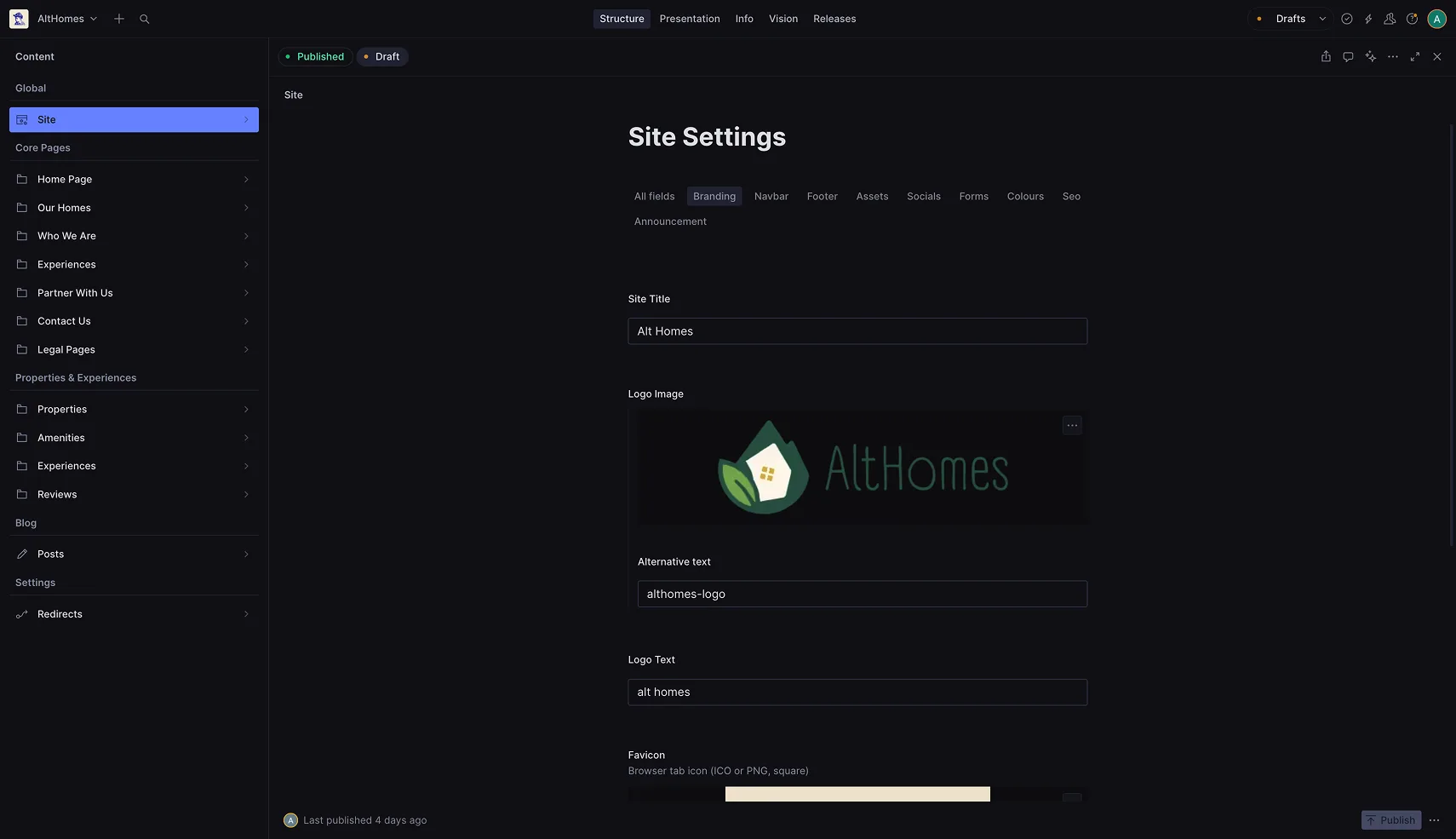
- 01 Content tree — Every page, home, and post lives in one editable tree.
- 02 Site settings — Branding, navbar, footer, colours, and SEO, all self-serve, no code.
- 03 Live fields — Edit a value; the published site reads straight from it.
- 04 Publish — Nothing goes live until the owner says so.
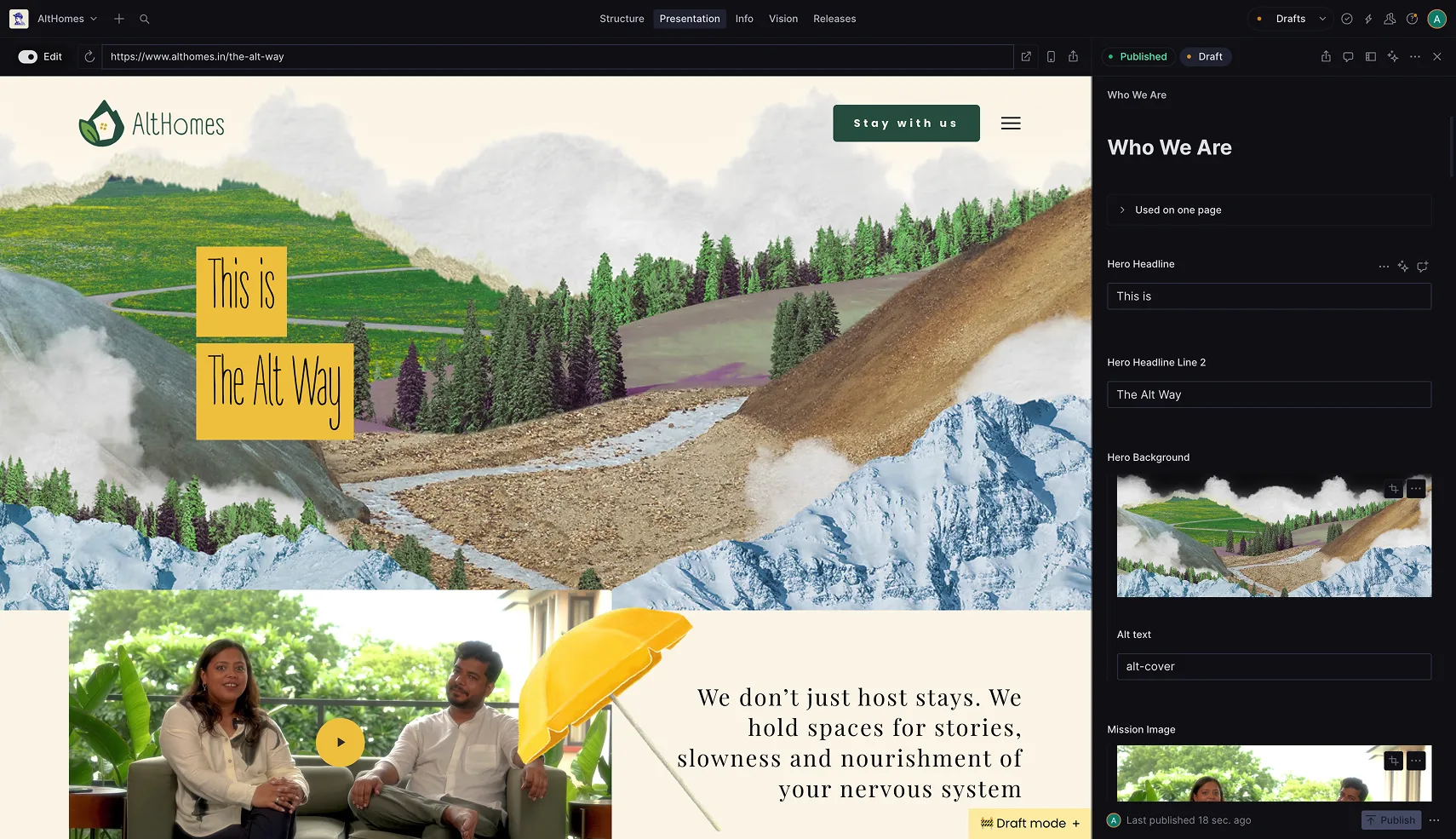
See it before it goes live
The finished page renders side by side with the editor. Reword a headline, swap a hero photo, or restructure a section, and watch it land exactly as a guest will see it, before anything is published.
- Edits render in the real page, not an abstract form.
- Mistakes get caught in private, never on the live site.
- Draft and published states stay cleanly separated.
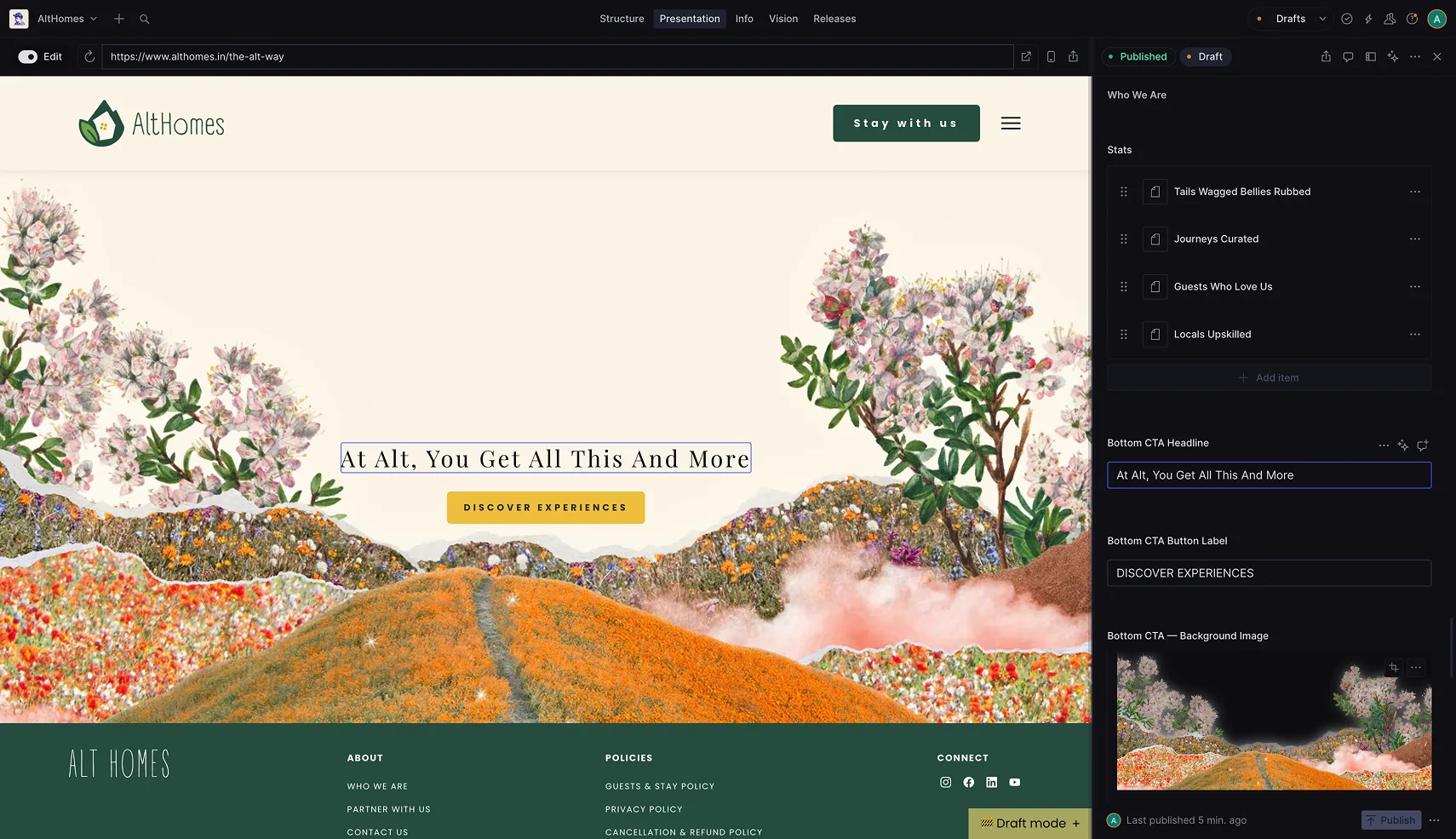
Click the page, edit the field
No hunting through a CMS for the right entry. The owner clicks an element on the preview and jumps straight to the field that controls it, so the page itself becomes the editing surface.
Real availability, not a fake form
Guests pick dates and see actual availability, pulled live from the property-management system the business already runs its calendars on. The site tells the truth about what's free because it reads the same source the owner trusts.
- Availability is read live from the PMS, never a stale copy.
- A RentalWise link binds each listing to its calendar.
- No double-bookings, no manual back-and-forth.
What It Does
Beyond editing and booking, the platform does the operational work on its own, the parts a guest never sees but always feels.
Enquiries that just work
Partner and contact messages arrive as clean, formatted emails, landing instantly in the inbox.
- A form gets filled, an email arrives. Simple on purpose.
- No spreadsheet, no leads rotting in a database nobody checks.
It sells itself on Google
Every page carries the right titles, descriptions, and a self-maintaining sitemap, so search engines understand and rank it.
- Add homes and articles, and the site stays discoverable on its own.
- Marketing doesn't decay the moment the developer leaves.
Fast pages, heavy photos
Property shots are huge and gorgeous, the kind that normally make a site crawl. Every image is auto-shrunk for the web with no visible quality loss.
- An 11 MB upload becomes ~54 KB on screen.
- The owner just uploads the nice photo and forgets about it.
Cheap to run, theirs to keep
Built to run on inexpensive, standard infrastructure and not locked to any one host.
- Low monthly bill; move providers whenever the business wants.
- They own the asset, not a lease on it.
None of this is a claim. It’s measured. The live site scores near-perfect across the board, with a largest paint just over a second and zero layout shift.
Google PageSpeed Insights · althomes.in · desktop · 18 Jun 2026
Under the Hood
The plain-language outcomes above are backed by deliberate engineering. For the technically curious, here’s the stack, the way data moves, and the properties that keep it honest.
Two data paths carry the whole product. One turns editor content into pages at build time; the other answers a guest’s date search, reading the real PMS calendar on the click without ever exposing the vendor credential.
Security by construction
Whole classes of attack are designed out, not filtered out.
- CMS token is Viewer scope, so the site can read content, never write it.
- Every form ends at a Resend email; no path writes to the CMS, killing injection.
- Server actions validate with Zod; origin checks compare hostname, not
startsWith.
Portable, theirs to keep
A standalone Next output plus a three-stage Docker build ships server, chunks, and assets, with no full node_modules.
- Small image, low RAM, runs as non-root.
- No Vercel-specific API was ever used.
- Let the project migrate Vercel → Railway purely to cut cost.
Types are the contract
Schema and code can’t silently drift. The generated types flow into every component.
- Every query uses
defineQuery(); a rawgroqtag breaks type-gen silently. - Remove a field still in use and the build breaks, not production.
Built with Agents
A site this self-sufficient took real engineering, and I didn’t write every line of it by hand. The build ran on an agentic platform: a set of specialized agents that plan, build, review, and test, each good at a single job. They don’t work in a line, they work in patterns. A hard feature becomes a small team that fans out and reconverges; a UI gets traded back and forth until it passes; a bug gets cornered and locked shut. Three of those patterns:
A front-end agent builds the screen; a tester agent renders it and pushes back. They trade revisions until it passes review — then it ships.
Hard features get a team. A planner scopes the work, a builder and a test-writer run at once — each in its own git worktree — and a reviewer signs off before anything touches main.
A reviewer flags the bug, a builder writes the fix, and a test-writer slams the door behind it with a regression test so it cannot come back.
It’s the same idea that runs through the whole project. Take the repetitive, error-prone work off a person’s plate and let a system handle it well. Here, that person was me.
What's Next: A Team That Never Sleeps
The website handles the screen. The next phase handles the phone, with AI voice agents that talk to guests in natural conversation, around the clock, in English and India’s local languages so callers are met in the language they’re comfortable in.
Answering the phone, 24/7
- Availability & booking “Is the Morni Hills home free next weekend?” gets a real answer, then a nudge toward booking.
- Property questions Check-in times, amenities, location, and policies: the routine questions, answered instantly at any hour.
- Lead capture When no human is free, the agent takes the caller’s details and logs the enquiry instead of dropping it.
- Guest support Existing guests get directions, booking tweaks, and on-stay help without waiting for office hours.
Reaching out at the right moment
- Abandoned bookings Someone browsed dates and didn’t finish. A well-timed call brings them back and recovers revenue that would otherwise evaporate.
- Campaign outreach New homes, seasonal offers, and promotions, delivered by voice to the right guests, turning a marketing idea into conversations.
The thread is the same one running through the whole project: take the repetitive, time-sensitive work off the owner’s plate and let the system handle it. First the website ran itself. Next, so does the front desk.
Reflections
Built and shipped solo across two environments, on infrastructure chosen to keep the running cost near zero.